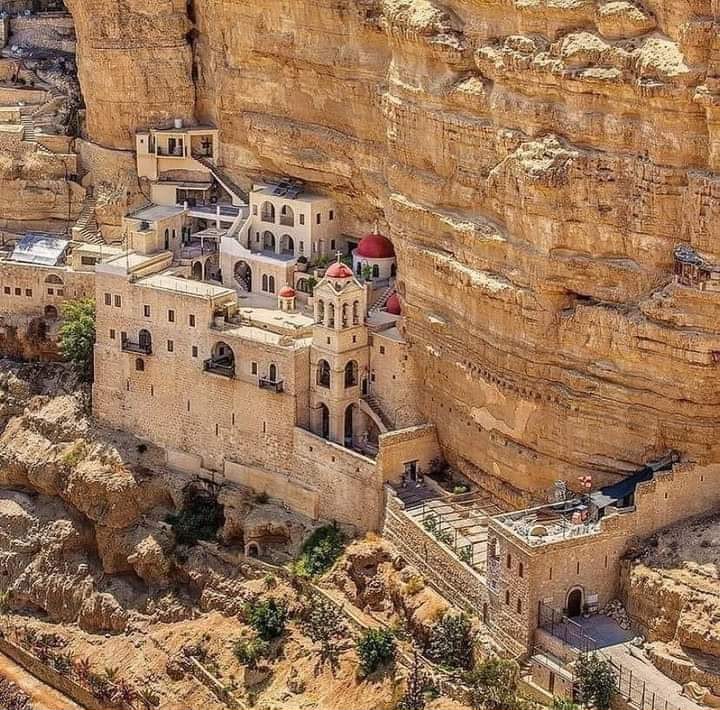
Perched on the rugged cliffs overlooking the ancient city of Jericho, Deir Quruntal (the Monastery of the Temptation) stands as one of Palestine’s most significant religious and historical landmarks. Revered as one of Christianity’s holiest sites, the monastery holds profound spiritual importance as the place traditionally associated with Jesus Christ’s forty days of fasting, prayer, and temptation in the wilderness. Rising approximately 350 meters above sea level, it commands sweeping views of Jericho and the Jordan Valley, offering a landscape that reflects centuries of faith, history, and civilization.
Seemingly suspended from the mountainside, the monastery is an architectural masterpiece carefully integrated into the natural rock face. Its complex consists of several interconnected sections, including the main church dedicated to the Annunciation, the Shrine Church, which forms an integral part of the sanctuary, and the natural cave carved into the heart of the mountain. According to long-standing Christian tradition, this cave is believed to be the place where Jesus Christ spent forty days fasting and where He was tempted by Satan. This sacred association gave the mountain its well-known names: the Mount of Temptation and the Mount of the Forty Days.
The monastery also includes a network of narrow passageways leading to upper chambers on either side, as well as numerous caves carved into the cliffs that once served as dwellings for monks and clergy. Over the centuries, the site developed into an important center of monastic life in the region.
The origins of the monastery date back to the Byzantine period. In 325 AD, Queen Helena, the mother of Emperor Constantine the Great, commissioned the construction of a monastery above the sacred cave to preserve its sanctity and commemorate its biblical significance. The site’s story, however, did not end with the Byzantine era. It continued to evolve through successive historical periods, including the Crusader era. Following their arrival in the Holy Land in 1099, the Crusaders built two churches on the site and named the mountain Mons Quarantana—Latin for “Mount of the Forty Days.” Today, the summit still bears the remains of the walls of an unfinished church.
The present-day monastery was constructed by the Greek Orthodox Patriarchate of Jerusalem in 1895 and continues to serve as an active place of worship while welcoming pilgrims and visitors from around the world. Among its most treasured features is the stone traditionally believed to be where Jesus sat during His forty-day fast and temptation, alongside a remarkable collection of icons and sacred artifacts that reflect the site’s enduring spiritual legacy.
Today, Deir Quruntal is a major destination on Christian pilgrimage routes throughout the Holy Land, attracting thousands of pilgrims and visitors each year who come to pray, reflect, and experience one of Christianity’s most revered sacred sites. Access to the monastery has become significantly easier with the construction of the Jericho cable car, which connects the city to the monastery, while the historic mountain trails continue to attract visitors seeking the traditional pilgrimage on foot.
As one of Palestine’s oldest surviving Christian landmarks, Deir Quruntal stands as a living symbol of the enduring Christian presence in the Holy Land and a testament to the rich religious and cultural heritage of Palestine. For centuries, it has preserved its spiritual significance and historical character, remaining a beacon of faith, contemplation, and resilience, and an integral part of the cultural and religious identity of Jericho and Palestine as a whole.