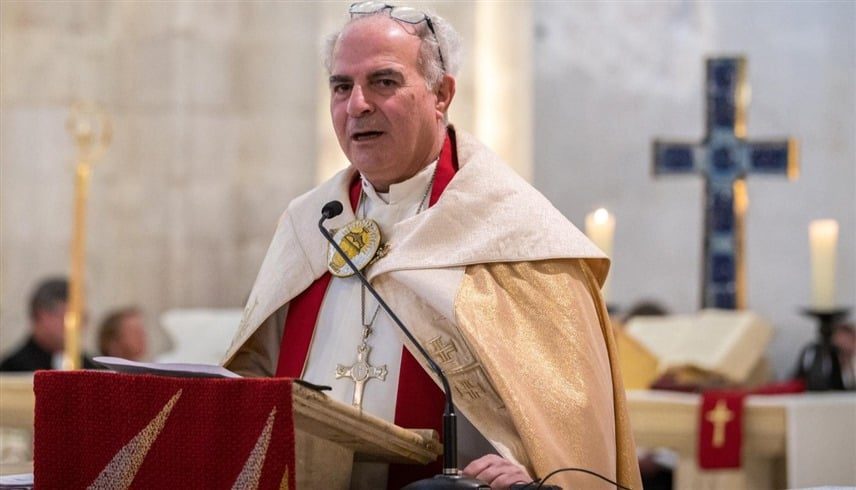
In response to the biased remarks made by members of the German parliamentary delegation regarding the sermon delivered by Bishop Sani Ibrahim Azar, Bishop of the Evangelical Lutheran Church in Jordan and the Holy Land and member of the Central Committee of the World Council of Churches, the Higher Presidential Committee for Church Affairs in Palestine issues the following statement:
During his sermon, Bishop Azar referred to the genocide being committed by Israel against the Palestinian people, particularly in the Gaza Strip. The Committee affirms that his message constitutes a courageous and truthful testimony, reflecting the Church’s moral voice in the face of injustice and its long-standing commitment to defending human dignity in the Holy Land. His words are grounded in United Nations reports and international legal references that document the ongoing humanitarian suffering of the Palestinian people under occupation.
The Bishop’s statements are supported by the findings of the International Court of Justice, which is currently considering the genocide case against Israel, and by the International Criminal Court in its ongoing investigation into war crimes committed in Gaza. They are also consistent with reports issued by the United Nations, Amnesty International, Human Rights Watch, and even Israeli human rights organizations, all of which confirm that Israel has committed grave violations of international humanitarian law and crimes against humanity.
The reactions of the German parliamentary delegation do not alter the reality; rather, they reveal a double standard, condemning those who describe a documented reality as it is, while ignoring the immense suffering of Palestinians living under siege and destruction. The position of the Palestinian Church is a stand of conscience and truth, guided not by political agendas but by the principles of faith, justice, and humanity.
The Committee expresses deep concern over the growing campaign to target Palestinian church leaders merely for expressing moral and humanitarian positions on the ongoing tragedy in Gaza and the West Bank, including Jerusalem. Efforts to silence the voice of the Palestinian Church are, in essence, efforts to silence the voice of conscience that continues to remind the world of its moral responsibility toward the oppressed.
Bishop Azar’s words were neither political accusations nor incitement, but rather a deeply humanitarian and pastoral message, an expression of the pain endured by the Palestinian people, and a reflection of the Church’s mission to bear witness to truth and justice. The Church cannot and will not remain silent in the face of oppression and bloodshed, in keeping with its spiritual and ethical calling to uphold human dignity and justice.
The Higher Presidential Committee for Church Affairs in Palestine calls upon local, regional, and international churches to stand in solidarity with the Palestinian Church against the ongoing campaigns of distortion and incitement. It also reaffirms the Church’s inherent right to freely express its faith-based and moral convictions, in accordance with the Universal Declaration of Human Rights and international law.